
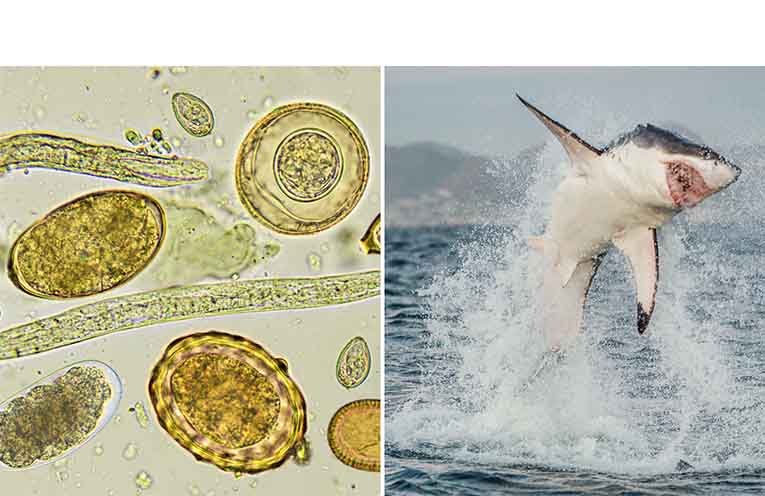
A WORLD-FIRST study by Charles Sturt University (CSU) has identified an ecosystem of parasites inside great white sharks.
The global study by researchers in CSU’s School of Agricultural, Environmental and Veterinary Sciences, and the Gulbali Institute for Agriculture Water and Environment, found evidence of at least 116 parasites inside the apex predator.
Professor in Veterinary Parasitology Shokoofeh Shamsi and co-researcher and Adjunct Lecturer in parasitology Associate Professor Diane Barton, examined records from Australia, the US, South Africa and New Zealand, as well as specimens in museum collections including the Smithsonian, Australian Helminthological Collection and EEB Biodiversity Research Collections.
“This global mapping shows enormous blind spots,” Prof. Shamsi said.
“[There are] vast regions with no parasite data at all, despite the great white sharks’ worldwide range.”
Most of the parasites are tapeworms (cestodes) and copepods.
Prof. Shamsi said protecting great white sharks requires understanding the unseen biological forces that shape them, including how parasites and other environmental pressures may influence their health and behaviour.
“We have next to no understanding of how these organisms influence shark health, energy use, decision-making, behaviour, susceptibility to stress, or even patterns we assume to be ‘attacks’.
“In other words, we are looking at sharks and seeing only the surface.”
Prof. Shamsi said Charles Sturt scientists at inland campuses study how activities on land travel downstream, influencing estuaries, reefs and even the health of marine predators.
She emphasised that while there is no evidence linking parasites to shark–human interactions, it is important to consider how human activities, such as pollution or microbial change in coastal waters, could subtly affect marine wildlife over time.
“They say parasites act as sentinels… revealing when ecosystems are stressed or breaking down, so studying shark parasites is therefore not just about sharks; it is a way of diagnosing the health of the entire ocean.
“The biggest discoveries about great white sharks may lie in what we have never studied ─ their parasites and microbiome.”
Co-author Assoc. Prof. Barton, highlighted the pivotal role that museum collections play in modern marine science.
She noted that these collections, combined with non-lethal research tools, allow scientists to study vulnerable species ethically and in far greater detail than ever before.
“Museum collections preserve irreplaceable biological material,” she said.