
Share via:


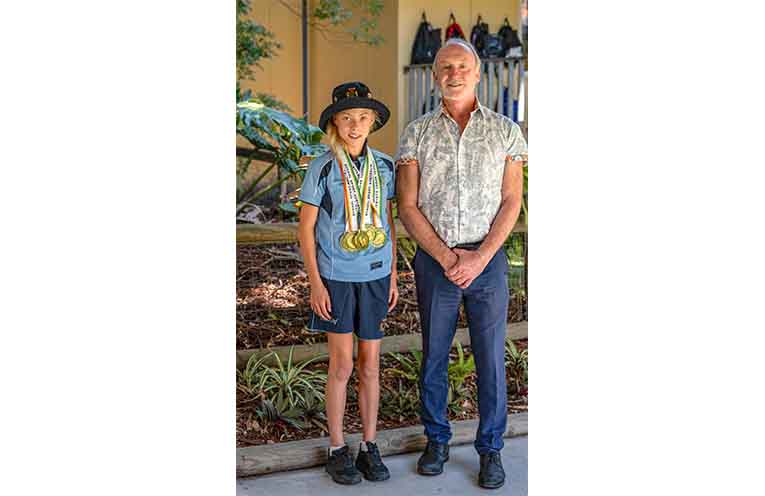
LAURIETON sprinter Scarlet Monk has claimed five gold medals at the School Sport Australia (SAA) Track and Field Championships, setting two national records in the process.
The national championships were held at the Australian Institute of Sport (AIS) Track and Field Centre in Canberra from 27-30 November.
Scarlet secured gold in five multi-class (MC) events: the Girls 12 years 100m, 200m and 800m races, the Girls 12 years 4x100m Relay and the Senior Girls (11-13) Long Jump.
The Camden Haven speedster also etched her name in the SAA history books, setting two new national records in the T35 category for the 200m and Long Jump events.
Scarlet, who has Cerebral Palsy, said she managed the nerves to compete at her best.
“I was nervous before each race but once I heard the gun I just ran really fast,” she said.
Scarlet also highlighted two special moments from the championships; celebrating her 200m win with her favourite ‘Hungry Jacks’ meal and ringing her school principal Mr Grant Timmins after claiming her first gold medal.
“The whole school community is extremely proud of Scarlet,” said Principal Timmins.
“On her return to school Scarlet went on a special visit to each classroom, sharing her experiences and her gold medals with the student body.
“Her huge smile never left her face all day.
“Apart from having five national gold medals to treasure forever, Scarlet also has her name in the record book for the 200m and Long Jump events.
“A very deserving outcome for a very determined girl.”
The multi-class (MC) classification system allows athletes with disabilities to compete in athletic events based on specific impairment categories.
MC competitors are divided into several groups of classifications, covering five impairment categories: Deaf and Hard of Hearing, Vision Impairment, Intellectual Impairment, Physical Impairment and Transplant Recipients.
Categories are labelled with a letter, followed by a two-digit number.
The letter is used to describe the event, eg T = Track.
The first digit tells you the category of impairment and the second digit tells you the degree of impairment.
The lower the second number, the greater the degree of impairment.
By Kim AMBROSE
You can help your local paper.
Make a small once-off, or (if you can) a regular donation.
We are an independent family owned business and our newspapers are free to collect and our news stories are free online.
Help support us into the future.
Share via: